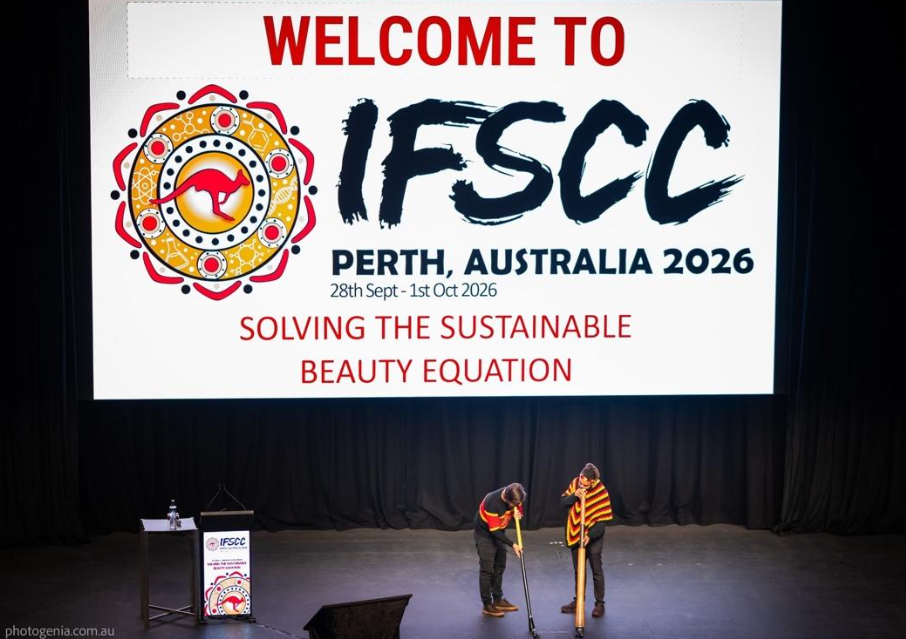
Solving the Sustainable Beauty Equation: Some Scientific Insights from Perth

IFSCC Congress, Perth, Australia, 28th September – 1st October, 2026
The challenge, set by the organizers of the 2026 IFSCC Congress, was to identify ways that the cosmetics industry can continue to lead innovation, while ensuring that this innovation is sustainable. Surely with 76 podium presentations from the best laboratories in the world, 748 posters and ~1250 delegates an answer could be found!
After numerous extensive discussions around this important topic, the take-home message was that while sustainability, particularly through the use of biotechnology, was clearly important, there were other recent developments within cosmetic science that also warranted attention: advances in the development of products and technologies for skin and hair longevity, personalization of beauty treatments, and the application of artificial intelligence (AI) to cosmetic science are all topics rising up the agenda. However, rigor and quality were still absolute requirements: presenters continually underscored the importance of robust product testing, and that substantiation of claims was necessary to maintain customer trust.

Sustainability
Presentations made during the Congress suggested that while sustainability is important, it is increasingly being integrated into ingredient development and manufacturing rather than being treated as a separate objective. In her keynote presentation, Dr Julie Edgar (Lubrizol) gave examples of ingredient manufacturing techniques that reduced carbon footprint, and solvent-free botanical extraction methods using sub-critical water volumes.[1] Future approaches, she said, will combine biotechnology, green chemistry, AI, automation, life-cycle assessment and circular design.
Artificial Intelligence
Another key theme was the use of AI to accelerate ingredient discovery and personalization. In his keynote presentation, Dr Fan Yang (Mageline) described how AI has been used at Mageline to create a ‘virtual skin cell’ (which included all the intracellular chemical reactions) for investigation into new actives in-silico. In another application, they used AI to analyze millions of pieces of consumer data to identify and investigate underlying trends that would normally be invisible to conventional data analysis approaches.[2] In other podium presentations, AI was used to identify new peptide sequences with skin anti-aging benefits,[3] while machine learning (ML) was applied to microbiome data for the identification of scalp health profiles and to develop a Microbial Age Index.[4] AI-use was also reported in the measurement of skin aging from facial skin images.[5]
Longevity
Longevity emerged as a broader framework – replacing the established anti-ageing approach – and was the subject of the keynote presentation from Dr Isabelle Castiel (L’Oreal).[6] An overarching model of skin aging processes, developed by L’Oreal, which incorporated structural alterations, signaling dysfunctions, and metabolic dysfunctions was shared, alongside the latest insights into hair longevity, particularly follicle exhaustion and hair loss. Other podium presentations considered the interaction between intrinsic ageing and the exposome, including UV radiation, pollution, heat and psychological stress. In recent years, the prolific publication of papers and posters on this topic suggest that longevity is a leading industry trend at present.
Hair & Scalp
Several presentations focused on new biological approaches to hair and scalp problems. Stress-related hair loss was investigated through neuro-hormonal and immunological pathways,[7] while microbiome profiling and lipidomics were used to identify different scalp types and consider the potential for ethnicity-related vulnerabilities.[8] For example, dandruff resulting from either dry or oily scalps were shown to have over-lapping but distinct molecular characteristics, with dry dandruff particularly associated with lipid impairment, reduced barrier-related proteins and increased desquamation.[9] A Lactobacillus ferment lysate was also investigated for its potential to restore pigmentation in greying hair, with transcriptomic, ex vivo follicle and clinical evidence presented.[10]
Formulation Science
Formulation science and delivery systems were another major focus. Sustainable cellulose nanocrystals were investigated as reflective UV-protection materials,[11] while D-phase emulsification was shown to produce smaller, more uniform sunscreen particles and an overall increased SPF.[12] Silicone-free microemulsions are being developed for hair care,[13] and bio-derived lipids from fermentation were explored for lamellar liquid-crystal systems.[14] Rheology, in combination with holographic microscopy, was proposed as a method for understanding inorganic sunscreen dispersion and stability.[15]
Conclusions
It is noteworthy that presentations repeatedly demonstrated the importance of technique validation and evidence quality. Questions to presenters continually raised concerns about placebo controls, sample diversity, active penetration, product stability, assay sensitivity, true mechanisms of action, and whether laboratory findings translate to real skin and hair. Overall, the conference demonstrated a move towards increasingly data-driven and biologically-targeted cosmetic innovation, while emphasizing that promising technologies still require robust validation, both clinically and in the real-world.
In the end, my thought was that while AI and biotechnology are creating thousands of exciting new active ingredients and formulations, the bottleneck in the process of product development remains ingredient screening and product testing. Perhaps the smart move now for TRI and other CROs is to look at ways of automating and speeding-up hair and skin assays to process the huge number of samples that these new AI methods are generating!
Keynote. Dr. Julie Edgar - The Evolution of New Ingredient Innovation and Development through a Sustainable Lens)
Keynote. Dr. Fan Yang - Artificial Intelligence Reshaping Cosmetic Innovation and Personalized Beauty
Lin Yu - Targeting Skin Longevity Pathways Through AI-Guided Senotherapeutic Ingredient Design
Emilio Baixauli - Microbial Age Index (MAI): Predicting Skin Aging Using the Microbiome
Yunkwan Kim - Beyond Visual Aging: Vision AI Identifies Aging Signs on Periocular Skin Reflecting Systemic Health Load
Keynote. Dr Isabelle Castiel - An integrative longevity approach to modern skin health
Seoyeon Kyung - Anticipating Hair Loss Before It Begins: Bi-national Population-Scale Predictive AI Model for Alopecia Areata
Kyung-Eun Lee - Decoding the Lipid Architecture of Global Scalp Archetypes: The Fortress-Shield-Coil Framework for Precision Scalp Care
Ling-Ling Liau - Metaproteomic Mapping of Dry Dandruff Reveals a Barrier-Deficient State and Guides Rational Scalp Care Development
Flavio Camargo Junior - New Alternative Treatment for Gray Hair: Ex Vivo and Clinical Evidence of a Biotechnological Active Ingredient
Heemuk Oh - Sustainable Cellulose-based Multifunctional Film for UV Protection, Color Tuning, and Wrinkle Reduction
Fan Liu - D-Phase Emulsification as a Solution for High-Performance Sunscreens: Formulating
Elena Zanca - Solving the Sustainable Hair Care Performance Equation: HLD-Based Approach to Silicone-Free Microemulsions
Zuxuan Zheng - Thermally Robust Lamellar Liquid Crystal Systems Enabled by Bio-Derived Fermented Lipids
Seoyoon Lee - From Equation to Solution: Decoding Inorganic Sunscreen Efficacy Through Rheology-Holography Analysis